The Charles River Floating Wetland explores an ecological intervention to reduce harmful algal blooms in the Charles, which threaten the river’s health and limit the feasibility of swimming. Reducing nutrient pollution from reaching the river remains a vital method for preventing blooms, but this approach depends on increasingly complex upland solutions. In-stream interventions like floating wetlands offer a complementary strategy that can absorb and remove nutrients from the water, increase biodiversity, support local ecological changes, and provide other co-benefits, like additional green space.
PROJECT VIDEO (2025)
In partnership with MassDCR, the CRC installed a floating wetland in the Charles River in Cambridge downriver of the Longfellow Bridge. Check out our video Charles River Floating Wetland: Our Journey, Our Vision (above), the general project information (below), our generous supporters, recent accomplishments, and please visit our engagement & education page.

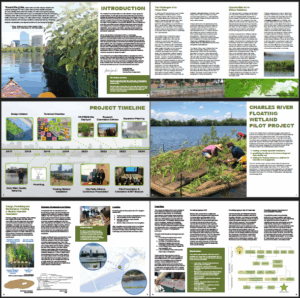
We recommend reading Lessons Learned from the Charles River’s First Floating Wetland for more in-depth information that details the project from idea to installation and from engagement through envisioned expansion.
During the island’s first three years, a Northeastern research group, led by Max Rome, collected data to understand the wetland’s impact on the local ecology. That work is published in the dissertation, From Water Quality to River Health, McNamara Buck Rome (2022). The CRC has used the wetland to engage youth and the community in understanding the ecology of the river and ways that we can all help make it a healthy and vibrant ecosystem. As interest in the project has grown, the CRC has been exploring opportunities for an expanded installation that can realize the full benefits that floating wetlands can provide.
LOCATION
The floating wetland is located in the Charles River along Cambridge Parkway, just downriver of the Longfellow Bridge near the mouth of the Broad Canal.
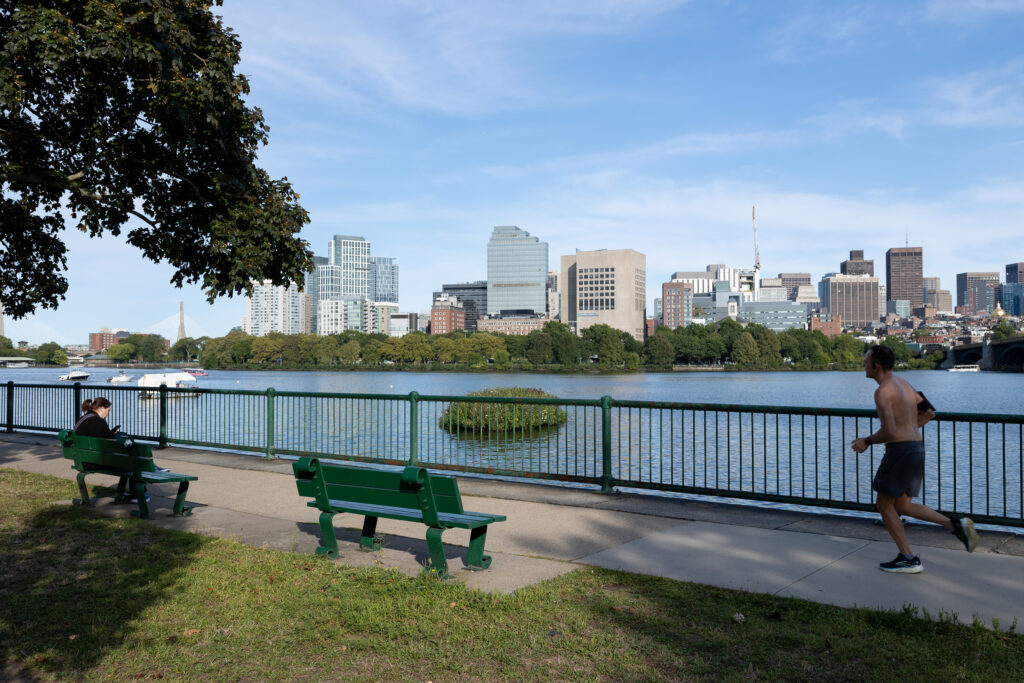
Photo: Artemisia Luk


SUPPORTERS
- Biomatrix Water
- The Boston Foundation
- BSA Foundation
- Cell Signaling Technology, Inc.
- City of Cambridge
- CHT Foundation
- Cultural Vision Fund
- Foth
- Heather and Robert Keane Family Foundation
- Horne Family Foundation
- Liberty Mutual Foundation
- MathWorks
- McKenzie Family Charitable Trust
- Metropolitan Area Planning Council
- MIT Sea Grant’s STREAM program
- Paddle Boston
- The ‘Quin Impact Fund Earthshot Boston Legacy Grant
- Reach Out for Schools
- Roaring Brook Family Foundation
- The Sasaki Foundation
- Takeda
- William Procter Scientific Innovation Fund
We are grateful to our early donors who made the design, permitting, installation and initial research on our floating wetland possible! As a multi-year initiative, ongoing support for the research, maintenance and engagement has ensured this project has far ranging impacts—from developing a data-driven expansion of floating wetlands for a healthier river to STEAM educational enrichment activities with youth!
Interested in supporting the continuing impact of this project? Contact Laura Jasinski at ljasinski@thecharles.org.
PROJECT GOALS
- Design, permit, and install a floating wetland to demonstrate the importance (and absence) of shoreline vegetation.
- Research the impact on local zooplankton populations and quantify the scale at which water quality could be affected and improved.
- Engage the public on the river’s health.
- Explore opportunities for an expanded installation

ACCOMPLISHMENTS AND RESOURCES
This project kicked off in the Fall of 2018. Since then, the team has:
- completed a 9-month residency at the Incubator at Sasaki (check out our storyboard and chapter of the Sasaki Foundation 2018-2019 Design Grant Research publication);
- determined an optimal modular product for our purposes, manufactured by Biomatrix Water, a leader in the Living Waters Cities movement;
- partnered with an experienced marine engineer, Foth, on the anchoring, permitting and installation;
- navigated the complex permitting process that included an Order of Conditions from the Cambridge Conservation Commission, Construction Access and Research permits from MassDCR, a Chapter 91 permit from MassDEP, and submission to the Army Corps; an overview of our permitting path is provided in this white paper;
- assembled the floating matrix, planted it with 19 species, and installed it into the Charles River (watch a time-lapse of the process!)
- engaged with and connected the community to the wetland, through youth kayak tours, STEAM activity kits, tabling events, and more; see our educational resources here;
- partnered with Northeastern University on their detailed three-year research program that studied the impacts the wetland has on the local ecology; this research was published in the dissertation From Water Quality to River Health, McNamara Buck Rome (2022).
- hosted three design sessions with agency, environmental and other stakeholders to develop criteria for a feasible and impactful expanded floating wetland installation;
- collaborated with other floating wetland project teams (Wild Mile in Chicago and National Aquarium in Baltimore) to learn from each other and advance this technology’s acceptance as a best management practice; our Northeastern research team co-authored a scientific paper with them;
- partnered with Perkins&Will to apply those criteria to locations along the Charles River and develop conceptual plans for what an expanded installation could be; their work is summarized here.
- celebrated the conclusion of the initial pilot phase of the project, with a multi-age event at MIT Museum and the release of a comprehensive report on the project: Lessons Learned from the Charles River’s First Floating Wetland;
- received a 2025 BSLA Design Award in the Research category by the Boston Society of Landscape Architects, where the jury “found the project locally relevant, praised its strong educational connection, and appreciated its real-life applicability”;
- received a 2025 ASLA Professional Honor Award in the Research category by the American Society of Landscape Architects, where the jury wrote: “This project was fascinating to review. To see the progress of this project from concept to prototype to implementation was great. This project would seem to have a widespread opportunity for implementation everywhere. Clarity of intent and impact, excellent engagement in design, implementation and monitoring, great post installation impact gathering, and good results. Longevity and scaling are of interest. One of the best projects because it includes 3 years of post-installation research.”
Have a question or want to learn more? Contact Laura Jasinski, ljasinski@thecharles.org.
Lead photo by Artemisia Luk